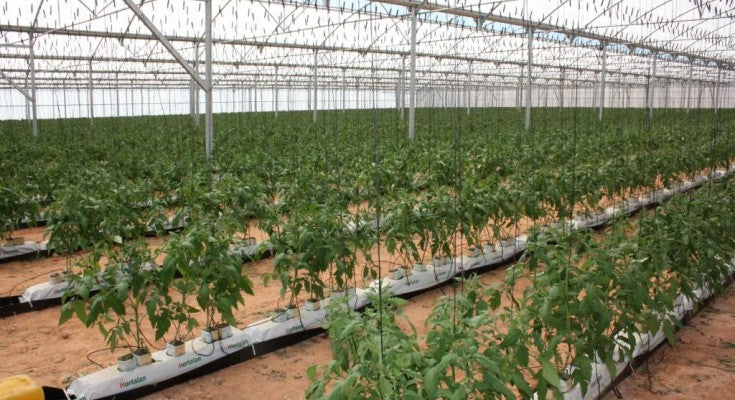



Nutrient Kit for Fruiting Plants – Vegetative Stage – 1 to 1000 L
- Regular price
-
€13,99 - Regular price
-
- Sale price
-
€13,99
Couldn't load pickup availability
PRODUCT DETAILS
The right nutrition for fruiting plants, from the start until fruit appears. This complete hydroponic nutrient kit for fruiting plants – vegetative stage provides all the essential macro and micronutrients for healthy, vigorous vegetative growth – preparing plants for abundant fruiting.
With enough to prepare between 1 and 1000 litres of nutrient solution, it is the ideal kit for strawberries, tomatoes, raspberries and other fruiting plants in NFT, DWC or other soilless hydroponic systems.
What’s in the kit
- 1 dose of Magnesium Sulphate — 16% MgO / 32% SO₃
- 1 dose of Monoammonium Phosphate (MAP) — 12% N / 61% P₂O₅
- 1 dose of calcium nitrate – 15.5% N / 19% Ca
- 1 dose of potassium nitrate – 13.5% N / 45.5% K₂O
- 1 dose of MKP (Monopotassium Phosphate) — 52% P / 34% K
- 1 dose of micronutrients – manganese sulphate, boric acid, copper, ammonium molybdate, zinc sulphate, iron 6%
- Dilution instructions included
💡 What makes this kit different from the leafy greens kit? The inclusion of MKP (monopotassium phosphate) – a nutrient rich in phosphorus and potassium that stimulates the transition from vegetative growth to flowering and fruiting. It is the key component for healthy, productive fruiting plants.
Which crops is it ideal for?
This kit is formulated for fruiting plants in the vegetative stage – from germination until the first fruits appear:
Main use:
- Strawberries
- Tomatoes (all varieties)
- Raspberries
- Blueberries (early stage)
- Peppers (vegetative stage)
- Cucumbers (vegetative stage)
- ⚠️ Note – vegetative vs. fruiting stage: use this kit until fruit appears. From then on, we recommend switching to the fruiting-stage nutrient kit, formulated to maximise fruit development and flavour.
How to prepare the nutrient solution – step by step
- ⚠️ Important: never mix the nutrients directly with each other – each must be dissolved separately before going into the tank.
- 1. Prepare the stock solutions: dissolve each nutrient separately in 5 litres of distilled water (one 5 L bottle per nutrient) — you will end up with 6 bottles of concentrated solution.
- 2. Add to the tank: for every 20 litres of water in the tank, add 100 ml from each bottle.
How do you control these parameters?
Nutrient solution
The plant consumes the solution, and every day the volume in the tank drops. This volume should be topped up every day with water, not with nutrient solution. Plants absorb much more water than nutrients, and since the nutrient solution is saline, topping up with solution every day salinises it until the dissolved salts exceed what the roots can tolerate. If this happens, plants stop growing – not from a lack of nutrients, but because of an excessively high osmotic potential at the roots.
Control the pH of the nutrient solution
As they take up nutrients, plant roots change the pH of the nutrient solution. The pH indicates how acidic or alkaline the nutrient solution is. Plants develop best between pH 5.5 and 6.5, and as they grow they change the pH of the solution. That is why the pH should be measured every day after topping up the solution with water. If it is outside the 5.5–6.5 range, adjust it with acid if above 6.5, or with base if below 5.5.
Control the electrical conductivity of the nutrient solution
As plants grow, the nutrients in the solution are used up and the solution becomes depleted. Eventually the solution can no longer supply the nutrients the plants need. At that point the solution should be replaced. One of the biggest problems is knowing when to change it.
A solution containing salts (nutrients) can conduct electric current. The higher the concentration of dissolved salts, the greater this conductivity. So a drop in electrical conductivity tells you when the nutrient solution needs changing. The easiest way to know the nutrient concentration is to use a conductivity meter.
One of the main reasons growers choose water-culture systems is that growth and maturity are usually 15–25% faster. Growers can still reach the desired plant size with a short vegetative period. So to get optimal early production from these systems, using the right nutrient mix and having the right conditions matter far more.